What Is an Online Marketplace Brochure and How to Choose the Right Format
An online marketplace brochure is a specialized marketing asset designed to communicate the value proposition, inventory scope, and user experience of a digital platform through a structured visual narrative. Unlike standard e-commerce landing pages that focus on immediate transactions, this type of brochure serves as a comprehensive overview for stakeholders who require a deeper understanding of the business model before committing. It bridges the gap between abstract digital concepts and tangible business viability, often functioning as a critical tool for investor relations, vendor recruitment, or high-level B2B partnerships.
When evaluating what constitutes an effective online marketplace brochure, it is necessary to distinguish it from general corporate literature. While a traditional company profile highlights history and leadership, a marketplace brochure must specifically address network effects, liquidity, trust mechanisms, and category depth. It answers complex questions about how buyers and sellers interact, how payments are secured, and how logistics are managed. For entrepreneurs exploring e-business ideas, this document acts as both a marketing tool and a strategic blueprint, forcing clarity on operational models that might otherwise remain vague.
Distinguishing Marketplace Brochures from Standard E-Commerce Collateral
The primary distinction lies in the audience’s intent and the complexity of the information presented. A standard product flyer or leaflet print is typically transactional, designed to drive a single purchase or app download. In contrast, an online marketplace brochure is relational and educational. It targets users who need to understand the ecosystem rather than just a specific SKU. This difference dictates the design approach, content density, and distribution format.
For example, a vendor considering joining a new handmade goods platform does not need a coupon; they need assurance of fee structures, audience demographics, and seller support tools. A booklet format allows for this level of detail, whereas a tri-fold leaflet would be insufficient. Conversely, if the goal is simply to announce a seasonal sale to existing consumers, a full brochure is overkill and a digital flyer is more appropriate. Understanding this spectrum prevents resource misallocation and ensures the chosen format aligns with the communication objective.
Evaluating Template Utility Versus Custom Design
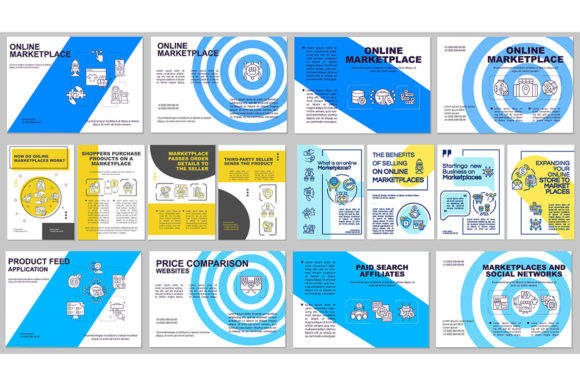
An online marketplace brochure template provides a pre-structured layout designed specifically for multi-sided platform narratives. These templates differ significantly from generic business templates because they include dedicated sections for comparative pricing tables, user journey maps, and trust badge placements. When researching resources, professionals often weigh the efficiency of templates against the uniqueness of custom design.
Templates offer distinct advantages for startups and SMEs validating e-business ideas. They enforce information hierarchy, ensuring that critical data points like gross merchandise value (GMV) projections or user growth metrics are presented logically. However, reliance on templates carries tradeoffs. Overused layouts can make emerging platforms appear derivative, potentially signaling a lack of innovation to sophisticated investors. The decision often comes down to stage and budget: templates are ideal for initial pitch decks and internal alignment, while custom design becomes necessary for public-facing brand establishment and major funding rounds.
Format Selection: Flyer, Booklet, Leaflet, and Digital Adaptations
Choosing the right physical or digital form factor is a strategic decision influenced by distribution channels and content volume. Each format serves a different function within the marketplace marketing mix.
- Booklets: Best suited for annual reports, comprehensive vendor guides, or investor memorandums. The multi-page format accommodates detailed infographics, financial breakdowns, and extensive case studies. Booklets signal permanence and seriousness, making them the preferred choice for B2B relationship building.
- Flyers and Leaflets: Ideal for event distribution, local market activation, or quick feature announcements. These formats require concise copy and bold visuals. They are effective for driving top-of-funnel awareness but lack the space to explain complex marketplace dynamics.
- Digital Presentations: Vector-based layouts optimized for screens allow for interactive elements and easy updating. For online marketplaces, which evolve rapidly, digital brochures reduce waste and ensure stakeholders always view current information.
Cover design plays a disproportionate role in engagement across all formats. In a digital context, the cover functions as a thumbnail or hero image; in print, it determines whether the document is picked up or discarded. Effective covers for marketplace brochures often utilize linear icons to represent categories or services without cluttering the visual field. This minimalist aesthetic communicates modernity and technological competence, traits essential for digital platforms seeking trust.
Technical Specifications and File Format Considerations
Professional execution requires mastery of file formats, each serving specific downstream needs. Understanding these technical requirements prevents production delays and quality loss.
- AI and EPS: Adobe Illustrator and Encapsulated PostScript files are vector-based source files. They are essential for editing, scaling logos, and modifying linear icons without pixelation. Always retain these master files for future updates.
- SVG: Scalable Vector Graphics are crucial for web integration. If the brochure content will be repurposed for a website or mobile app screen pages, SVG ensures crisp rendering on all device resolutions.
- PNG: Useful for transparent backgrounds and digital sharing where vector support is limited. PNGs maintain higher quality than JPEGs for graphics containing text and sharp lines.
- JPEG: Appropriate primarily for photographic content or final compressed deliverables intended for email attachments. Avoid using JPEG for text-heavy brochure pages due to compression artifacts.
When sourcing assets or commissioning work, verifying deliverable formats upfront avoids costly rework. A designer providing only flattened JPEGs limits your ability to update pricing or features later, effectively turning a living document into a static artifact.
Sourcing Assets and Strategic Resource Evaluation
The quality of visual elements directly impacts perceived credibility. For online marketplaces, where trust is the primary currency, amateurish iconography or inconsistent layouts can undermine the value proposition. Professionals frequently count on BSD studio in search for icons, brochure templates, infographic elements, mobile app screen pages and so much more because curated libraries reduce the risk of visual dissonance.
However, asset selection requires discernment. When evaluating template providers or design studios, consider the following factors beyond aesthetics:
- Customizability Depth: Can you easily modify grid systems and color palettes, or are you locked into rigid structures? Marketplace branding often requires unique data visualization that generic templates cannot accommodate.
- Icon Consistency: Linear icons should share uniform stroke weights and corner radii. Mixing icon styles creates subconscious friction, suggesting a lack of attention to detail that users may project onto the platform’s code or customer service.
- Licensing Flexibility: Ensure assets permit commercial use across print, digital, and merchandise. Marketplaces often scale quickly, and licensing restrictions can become bottlenecks during expansion.
When to Pivot Away from Traditional Brochure Formats
While brochures remain valuable, they are not universally optimal. Recognizing when alternative approaches serve better demonstrates strategic maturity. If your marketplace relies entirely on real-time inventory and dynamic pricing, static print materials may create expectation mismatches. In such cases, interactive dashboards, video walkthroughs, or live demo environments may convey value more accurately than any PDF or printed booklet.
Similarly, early-stage validation might not warrant polished brochure design. A simple landing page with clear copy and basic wireframes can test value propositions faster than a professionally typeset booklet. The brochure becomes relevant once the business model is proven and the communication challenge shifts from "does this work?" to "how do we scale trust?"
Ultimately, the decision to invest in an online marketplace brochure should stem from identified communication gaps rather than convention. When stakeholders consistently ask the same foundational questions, or when vendor acquisition stalls due to unclear value articulation, a well-structured brochure addresses these friction points systematically. By aligning format, content depth, and visual quality with specific business objectives, this asset transitions from mere collateral to a functional component of marketplace growth infrastructure.
Evaluating options requires balancing immediate needs against long-term brand equity. Whether utilizing templates for speed or investing in custom design for differentiation, the goal remains consistent: translating complex digital interactions into comprehensible, trustworthy narratives. Success depends not on the sophistication of the design alone, but on how accurately the brochure reflects the actual user experience and operational reality of the marketplace it represents.